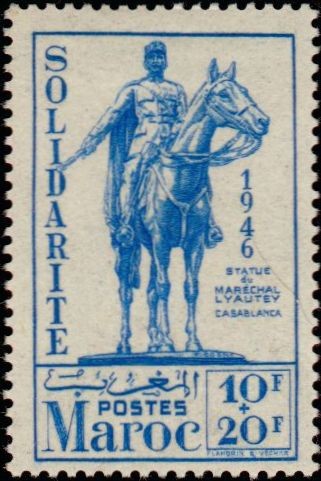
General Lyautey (1854-1934) - 30 franc
The visual composition highlights French colonial iconography by depicting the Equestrian Statue of Marshal Lyautey in Casablanca. The monument, sculpted by François Cogné and unveiled in the 1930s, honors the first French Resident-General of Morocco, portrayed here in military uniform atop a horse.
Marshal Hubert Lyautey (1854–1934) was a prominent French military officer and colonial administrator who served as the highly influential first French Resident-General of Morocco from 1912 to 1925. Renowned for his distinct philosophy of indirect rule, Lyautey favored a policy of cultural association rather than assimilation. Instead of dismantling native governance, he made a deliberate effort to rule through existing Moroccan institutions, working closely alongside the Sultan and traditional elites while strictly respecting and preserving Islamic laws, religious structures, and North African cultural customs.
During his tenure, Lyautey left a massive physical mark on the Moroccan landscape by orchestrating a sweeping national modernization and engineering program. Collaborating with visionary urban planners, he established entirely new administrative and commercial quarters—known as the Villes Nouvelles—directly alongside historic Moroccan medinas, intentionally leaving the old cities intact to preserve their rich architectural heritage. Under his direct oversight, Rabat was designated as the official administrative capital of the protectorate, while Casablanca was transformed from a modest coastal town into a booming modern deep-water port and the economic engine of North Africa.
Lyautey's extensive career across the French colonial empire, which included critical postings in Indochina, Madagascar, and Algeria, culminated in his appointment as the French Minister of War during World War I and his promotion to Marshal of France in 1921. Following his death in 1934, he was buried in a grand, custom-built mausoleum in Rabat to honor his profound connection to the country. Though his remains were repatriated to the Hôtel des Invalides in Paris in 1961 following Morocco's independence, his legacy remains permanently captured in twentieth-century history, documented through prominent national monuments like his grand equestrian statue in Casablanca and specialized historical stamp series.
Marshal Hubert Lyautey (1854–1934) was a prominent French military officer and colonial administrator who served as the highly influential first French Resident-General of Morocco from 1912 to 1925. Renowned for his distinct philosophy of indirect rule, Lyautey favored a policy of cultural association rather than assimilation. Instead of dismantling native governance, he made a deliberate effort to rule through existing Moroccan institutions, working closely alongside the Sultan and traditional elites while strictly respecting and preserving Islamic laws, religious structures, and North African cultural customs.
During his tenure, Lyautey left a massive physical mark on the Moroccan landscape by orchestrating a sweeping national modernization and engineering program. Collaborating with visionary urban planners, he established entirely new administrative and commercial quarters—known as the Villes Nouvelles—directly alongside historic Moroccan medinas, intentionally leaving the old cities intact to preserve their rich architectural heritage. Under his direct oversight, Rabat was designated as the official administrative capital of the protectorate, while Casablanca was transformed from a modest coastal town into a booming modern deep-water port and the economic engine of North Africa.
Lyautey's extensive career across the French colonial empire, which included critical postings in Indochina, Madagascar, and Algeria, culminated in his appointment as the French Minister of War during World War I and his promotion to Marshal of France in 1921. Following his death in 1934, he was buried in a grand, custom-built mausoleum in Rabat to honor his profound connection to the country. Though his remains were repatriated to the Hôtel des Invalides in Paris in 1961 following Morocco's independence, his legacy remains permanently captured in twentieth-century history, documented through prominent national monuments like his grand equestrian statue in Casablanca and specialized historical stamp series.