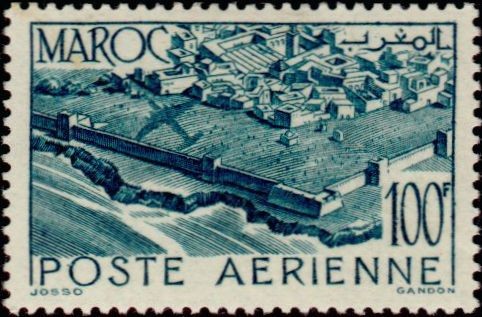
Aircraft over Salé - 100 franc
The post-World War II period in Morocco was marked by a massive expansion of transcontinental civil aviation and the establishment of regular aerial postal routes linking North Africa directly with global commerce. Following the geopolitical realignments of the late 1940s, the region emerged as a critical strategic corridor for international transport, military logistics, and commercial passenger lines. This modernization wave introduced advanced multi-engine aircraft to the skies, fundamentally transforming the speed of communication and integrating the territory's major regional hubs into the rapidly developing international transit networks of the mid-century.
Concurrently, this era of technological acceleration highlighted the enduring historical and architectural identity of Morocco's imperial cities, whose ancient mud-brick ramparts, monumental gates, and dense medina quarters had stood for centuries as symbols of regional sovereignty. The dramatic juxtaposition of cutting-edge aviation crossing over these medieval urban centers reflected a broader administrative effort to balance structural modernization with the preservation of local cultural heritage. These historic urban centers, serving as vital cultural and administrative hubs, became central to the post-war tourism boom and regional pride, showcasing Morocco's ability to maintain its deep-seated traditions while actively embracing the globalized future of the twentieth century.
Concurrently, this era of technological acceleration highlighted the enduring historical and architectural identity of Morocco's imperial cities, whose ancient mud-brick ramparts, monumental gates, and dense medina quarters had stood for centuries as symbols of regional sovereignty. The dramatic juxtaposition of cutting-edge aviation crossing over these medieval urban centers reflected a broader administrative effort to balance structural modernization with the preservation of local cultural heritage. These historic urban centers, serving as vital cultural and administrative hubs, became central to the post-war tourism boom and regional pride, showcasing Morocco's ability to maintain its deep-seated traditions while actively embracing the globalized future of the twentieth century.