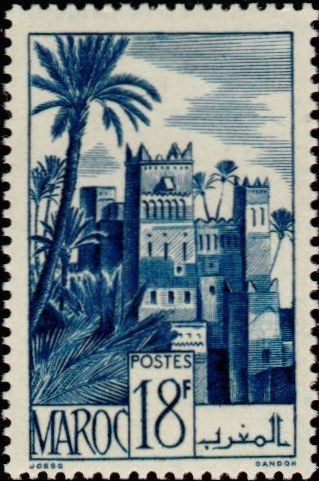
Kasbah Tifoultoute Ouarzazate - 18 franc
The region of Ouarzazate and its surrounding desert valleys underwent a profound geopolitical and administrative transformation during the first half of the twentieth century. Strategically positioned at the crossroads of the ancient trans-Saharan trade routes linking sub-Saharan Africa with northern Moroccan cities, this rugged territory was historically dominated by powerful southern tribal confederations. In the 1920s and 1930s, the area became a focal point of intense pacification campaigns under the French Protectorate, which established a major military garrison and administrative outpost there. This era was deeply defined by the soaring influence of the Glaoui clan—most notably Thami El Glaoui, the Pasha of Marrakech—who cooperated with colonial authorities to consolidate control over the High Atlas mountain passes and pre-Saharan valleys using a vast network of fortified strongholds.
Central to this era of regional integration was the strategic utilization and preservation of massive earthen strongholds like the historic Kasbah Taourirt. These multi-tiered, rammed-earth fortresses served as the administrative headquarters, palatial residences, and military storehouses for the ruling elites, controlling the flow of goods and tribal alliances across the desert frontier. By the late 1940s and early 1950s, as the region stabilized, these monumental architectural complexes became centerpiece symbols for regional cultural campaigns and early tourism initiatives. The deliberate promotion of the southern desert landscape not only highlighted Morocco's unique earthen engineering traditions to the global stage but also laid the historical and infrastructural groundwork for Ouarzazate's mid-century transition into a prominent cultural crossroads and an iconic international location.
Central to this era of regional integration was the strategic utilization and preservation of massive earthen strongholds like the historic Kasbah Taourirt. These multi-tiered, rammed-earth fortresses served as the administrative headquarters, palatial residences, and military storehouses for the ruling elites, controlling the flow of goods and tribal alliances across the desert frontier. By the late 1940s and early 1950s, as the region stabilized, these monumental architectural complexes became centerpiece symbols for regional cultural campaigns and early tourism initiatives. The deliberate promotion of the southern desert landscape not only highlighted Morocco's unique earthen engineering traditions to the global stage but also laid the historical and infrastructural groundwork for Ouarzazate's mid-century transition into a prominent cultural crossroads and an iconic international location.