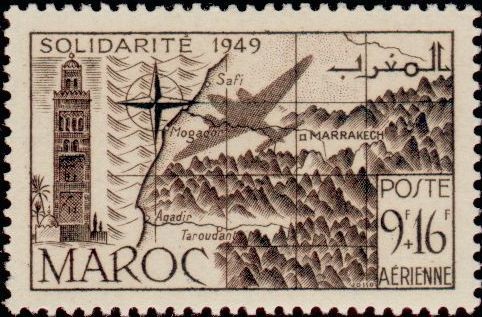
Map of the Southwest
The year 1949 marked a critical phase of socioeconomic mobilization and administrative integration across southwestern Morocco under the French Protectorate. Driven by the annual winter solidarity campaigns (Solidarité 1949), administrative authorities focused heavily on raising public relief funds to mitigate post-World War II economic hardships, severe inflation, and regional inequalities. This era saw a concerted effort to economically bridge the prominent inland imperial capital of Marrakech with the vital southwestern Atlantic coastal and pre-Saharan hubs of Safi, Mogador, Agadir, and Taroudant. These expanding southern territories became increasingly vital to the colony's post-war recovery, serving as core centers for fishing industries, mineral extraction, agricultural commerce, and regional administrative oversight.
Concurrently, this period witnessed the rapid mapping and expansion of commercial and postal aviation networks across the rugged terrain of the High Atlas Mountains and the southern Atlantic coastline. The skies over southwestern Morocco became a strategic transit corridor, linking coastal ports directly with the interior plains and established desert trading networks. Upgraded airfields and newly implemented navigational grids, particularly connecting the Marrakech hub with coastal outposts like Agadir, drastically cut down communication times and revolutionized mid-century logistics. By pairing these advanced aeronautical developments with state-directed social welfare programs, the post-war administration sought to project structural modernization and territorial cohesion, anchoring Morocco's historic southern bastions firmly into the global transport networks of the mid-twentieth century.
Concurrently, this period witnessed the rapid mapping and expansion of commercial and postal aviation networks across the rugged terrain of the High Atlas Mountains and the southern Atlantic coastline. The skies over southwestern Morocco became a strategic transit corridor, linking coastal ports directly with the interior plains and established desert trading networks. Upgraded airfields and newly implemented navigational grids, particularly connecting the Marrakech hub with coastal outposts like Agadir, drastically cut down communication times and revolutionized mid-century logistics. By pairing these advanced aeronautical developments with state-directed social welfare programs, the post-war administration sought to project structural modernization and territorial cohesion, anchoring Morocco's historic southern bastions firmly into the global transport networks of the mid-twentieth century.