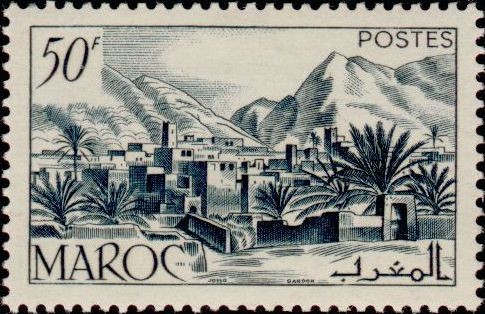
The Todra Valley - 50 franc
The Todra Valley and the surrounding pre-Saharan frontier of southeastern Morocco underwent a profound geopolitical and structural transition during the first half of the twentieth century. Historically managed by independent Amazigh tribal confederations, such as the powerful Aït Atta, this rugged territory along the southern foothills of the High Atlas Mountains was a critical corridor for trans-Saharan trade and seasonal pastoral migration. During the late 1920s and early 1930s, the region became a primary focus of intensive pacification campaigns by the French Protectorate authorities, who sought to secure the mountain passes and remote river valleys. The establishment of military outposts and administrative centers at strategic hubs like Tinerhir permanently altered the regional governance, shifting the area from traditional tribal autonomy toward integration into a centralized national framework.
Central to the region's enduring historical and cultural identity was the development of the lush Todra oasis, where ancient, sophisticated water management networks sustained agriculture amidst an otherwise hyper-arid desert plateau. The valley's landscape was heavily defined by architectural complexes of rammed-earth fortresses and fortified communal villages, which had protected local communities from tribal warfare and desert raids for centuries. By the late 1940s and early 1950s, as the frontier fully stabilized, these dramatic river valleys and their unique earthen engineering traditions became focal points for regional administrative development and early cultural tourism initiatives. This deliberate integration highlighted the strategic and cultural value of the pre-Saharan oases, positioning them as essential symbols of Morocco's diverse geographical heritage in the mid-century era.
Central to the region's enduring historical and cultural identity was the development of the lush Todra oasis, where ancient, sophisticated water management networks sustained agriculture amidst an otherwise hyper-arid desert plateau. The valley's landscape was heavily defined by architectural complexes of rammed-earth fortresses and fortified communal villages, which had protected local communities from tribal warfare and desert raids for centuries. By the late 1940s and early 1950s, as the frontier fully stabilized, these dramatic river valleys and their unique earthen engineering traditions became focal points for regional administrative development and early cultural tourism initiatives. This deliberate integration highlighted the strategic and cultural value of the pre-Saharan oases, positioning them as essential symbols of Morocco's diverse geographical heritage in the mid-century era.