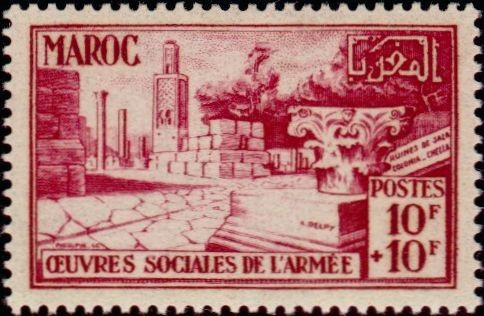
Ruins of Sala Colonia to Chella - 20 franc
The historic site of Chellah, located on the outer edge of the administrative capital of Rabat, represents one of the most remarkable archaeological intersections of classical Mediterranean antiquity and medieval Islamic heritage in North Africa. Originally flourishing as Sala Colonia, a thriving river port and critical western outpost of the Roman Empire's Mauretania Tingitana province, the urban center served as a key locus for maritime trade and Roman military administration. Centuries after the decline of Roman authority, the abandoned stone foundations and paved roadways were uniquely reoccupied during the medieval era. Under the Almohad and subsequent Marinid dynasties in the thirteenth and fourteenth centuries, the ancient site was transformed into a fortified royal necropolis, enclosed by monumental rammed-earth walls and dominated by an elegant stone minaret, transforming a classical Roman trading hub into a sacred royal burial ground and spiritual sanctuary.
During the post-World War II era, this multilayered architectural monument became a primary focal point for state-directed historical documentation, archaeological stabilization, and early cultural tourism initiatives under the French Protectorate. The unique juxtaposition of classical Corinthian capitals and ancient Roman forums standing alongside medieval Islamic ruins provided a powerful visual narrative of Morocco's diverse, millennia-old historical identity to a burgeoning mid-century international audience. Concurrently, the preservation of this heritage was leveraged to support contemporary social welfare programs, such as the Army Social Works (Œuvres Sociales de l'Armée). By issuing specialized semi-postal stamps featuring detailed artistic renderings of Chellah by prominent regional painters like Charles Delpy, the post-war administration successfully funneled public philanthropy and philatelic surtaxes directly into relief funds, medical assistance, and housing projects for veterans and families recovering from the disruptions of the global conflict.
During the post-World War II era, this multilayered architectural monument became a primary focal point for state-directed historical documentation, archaeological stabilization, and early cultural tourism initiatives under the French Protectorate. The unique juxtaposition of classical Corinthian capitals and ancient Roman forums standing alongside medieval Islamic ruins provided a powerful visual narrative of Morocco's diverse, millennia-old historical identity to a burgeoning mid-century international audience. Concurrently, the preservation of this heritage was leveraged to support contemporary social welfare programs, such as the Army Social Works (Œuvres Sociales de l'Armée). By issuing specialized semi-postal stamps featuring detailed artistic renderings of Chellah by prominent regional painters like Charles Delpy, the post-war administration successfully funneled public philanthropy and philatelic surtaxes directly into relief funds, medical assistance, and housing projects for veterans and families recovering from the disruptions of the global conflict.